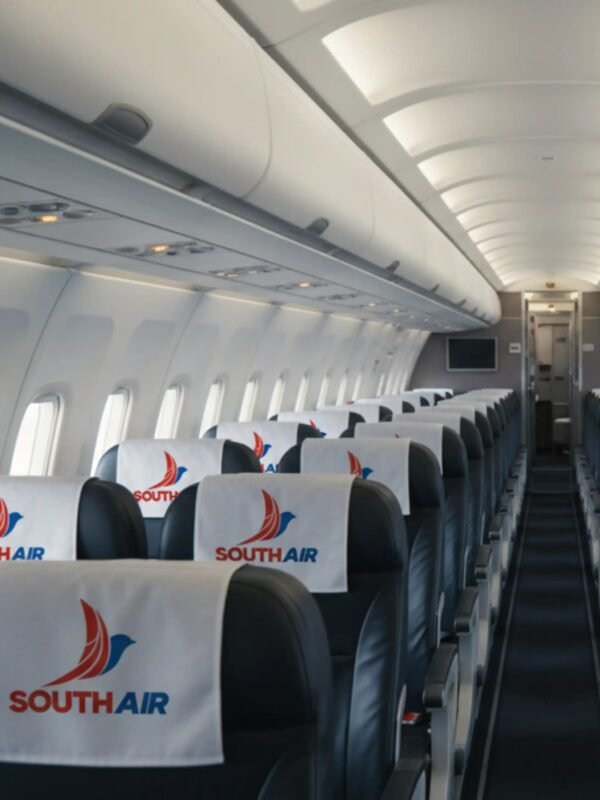
Most aviation investment pitches ask you to bet on a plan. South Air is asking you to look at what’s already flying.
South Air currently operates a live network spanning eleven cities: Islamabad, Karachi, Quetta, Peshawar, Lahore, Multan, Sukkur, Bahawalpur, Turbat, Rahim Yar Khan, and Gwadar. Karachi functions as the central hub, connecting six of those destinations directly. This isn’t a route map on a pitch deck. It’s an operating schedule.
For anyone evaluating Pakistan’s regional aviation sector as an investment opportunity, that distinction matters more than it sounds.
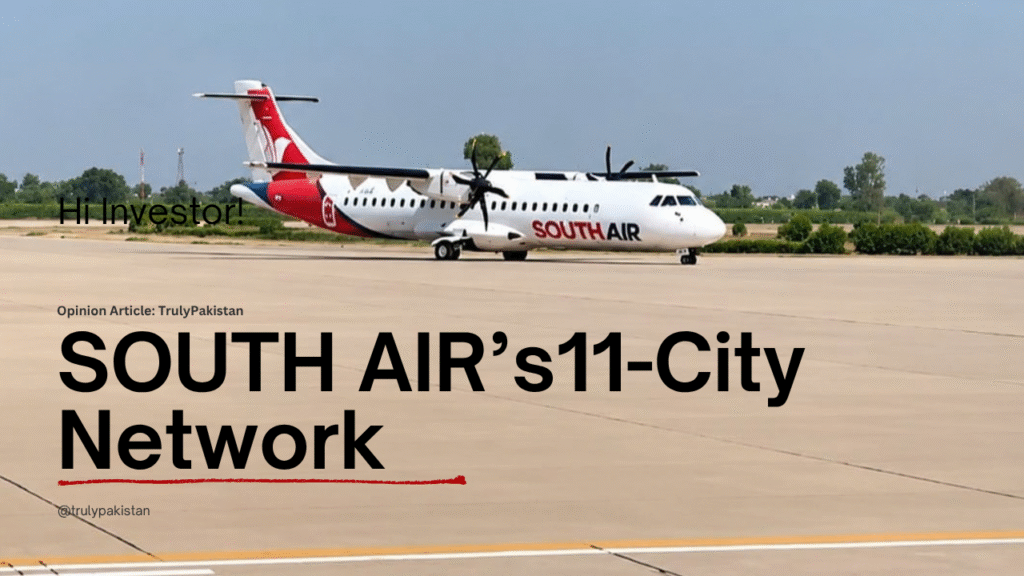
The parts that usually take years are already done
Launching an airline in Pakistan requires clearing a specific regulatory gate. A Tourism Promotion and Regional Integration (TPRI) licence, introduced under the 2019 National Aviation Policy, was designed to pull private carriers into regional markets the big airlines had already abandoned. South Air holds this licence, along with an Air Operator Certificate from the Pakistan Civil Aviation Authority. Those are the standard approvals required before a single passenger can board.
The airline has also done something most new regional carriers in Pakistan’s history haven’t managed. It built a functioning supply chain around the licence. South Air’s aircraft maintenance runs through a partnership with Pakistan International Airlines. Its fuelling is contracted with PSO. Neither of those is a small thing in a market where four TPRI licences were issued back in 2021, and a year later, only one of those four carriers was actually operating a commercial flight.
South Air is the exception the licence was designed to produce. That’s the headline for an investor. The regulatory and operational scaffolding that usually kills regional carriers before they get off the ground has already been built here.
Who’s actually behind it
South Air isn’t a standalone startup betting everything on one product line. It’s a subsidiary of SOS Group, a diversified Pakistani conglomerate with operations spanning security, energy, technology, healthcare, education, and shipping. That matters for the same reason it matters in any capital-intensive sector. A parent company with cross-sector cash flow and existing institutional relationships de-risks an aviation bet in a way a first-time founder with a single aircraft cannot.
The airline’s fleet reflects steady, disciplined scaling rather than overreach. It started commercial operations on a Karachi–Multan route in late 2025, then formally launched its broader scheduled network (Karachi, Islamabad, Bahawalpur, Gwadar, Sukkur, and Rahim Yar Khan) in mid-2026. The fleet itself stood at two ATR 72 aircraft by mid-year, with a publicly stated plan to reach four by year-end. That’s a fleet growing in step with route additions, not a fleet sitting idle waiting for demand to appear.
The market this network sits inside
Pakistan’s domestic aviation sector isn’t shrinking, and it isn’t stagnant, but it also isn’t a market anyone should oversell. Domestic passenger traffic is forecast to grow from roughly 7.6 million in 2023 to about 8.3 million by 2028, a modest annual growth rate. What makes South Air’s position interesting isn’t overall market growth. It’s where South Air is choosing to fly.
Rahim Yar Khan had no regular scheduled flights at all from 2023 until South Air arrived. Bahawalpur was in a similar position after a previous carrier withdrew service ahead of privatization. These aren’t routes South Air is competing for against PIA, Airblue, or Fly Jinnah. They’re routes those carriers had already abandoned. This is a market South Air isn’t fighting for share in. It’s the only operator in it.
The economic case for that kind of connectivity is measurable, not speculative. According to IATA’s “The Value of Air Transport to Pakistan” report, built on Oxford Economics 2023 data, tourism supported by aviation contributes $952.1 million to Pakistan’s GDP and employs 227,900 people. That figure sits inside the sector’s total impact of $5.6 billion in GDP and 683,900 jobs. International tourists arriving by air are separately estimated to contribute $1.6 billion annually to local businesses through direct spending. Every new route that connects a previously unserved city into that ecosystem is, by definition, expanding the base that number is measured against.
The honest caveat
None of this is a guarantee. Fuel now accounts for roughly 50 to 60% of operating costs at major Pakistani carriers, up from around 30% previously. That’s a cost structure that punishes thin routes disproportionately. And an average domestic ticket in Pakistan represents a meaningful share of local wages, which caps who this connectivity currently serves. South Air’s current frequencies on several routes are still weekly rather than daily: connectivity, not yet a fully proven business model.
These are the standard risks of an early-stage regional carrier, not red flags specific to this one. What’s specific to South Air is that the licence is secured, the maintenance and fuel supply chains are contracted, the fleet is scaling on schedule, and the network already spans eleven cities with a named institutional backer standing behind it.
The infrastructure question, the one that has stalled every other TPRI-licensed carrier before it, appears to already be answered.
Sources
- IATA, “The Value of Air Transport to Pakistan” (Oxford Economics, 2023)
- South Air official route map, southair.com.pk/route
- Wikipedia, “South Air” (corporate/fleet data)
- alhamdantravel.com, “South Air Pakistan: Routes, Fares, Booking & Fleet Guide” (Aug 2026)
- History of PIA forum, CEO Nishat Fatima press briefing, Islamabad Serena Hotel, May 24, 2026
- TechJuice, “New Private Airline to Launch Domestic Flights From July 16” (Jul 2026)
- Pakistan Civil Aviation Industry Outlook 2024–2028, via Reportlinker
- The Express Tribune / Pakembassytashkent, TPRI licence framework, 2019 National Aviation Policy
- ch-aviation / Dawn, TPRI licensing track record, 2021–2022